


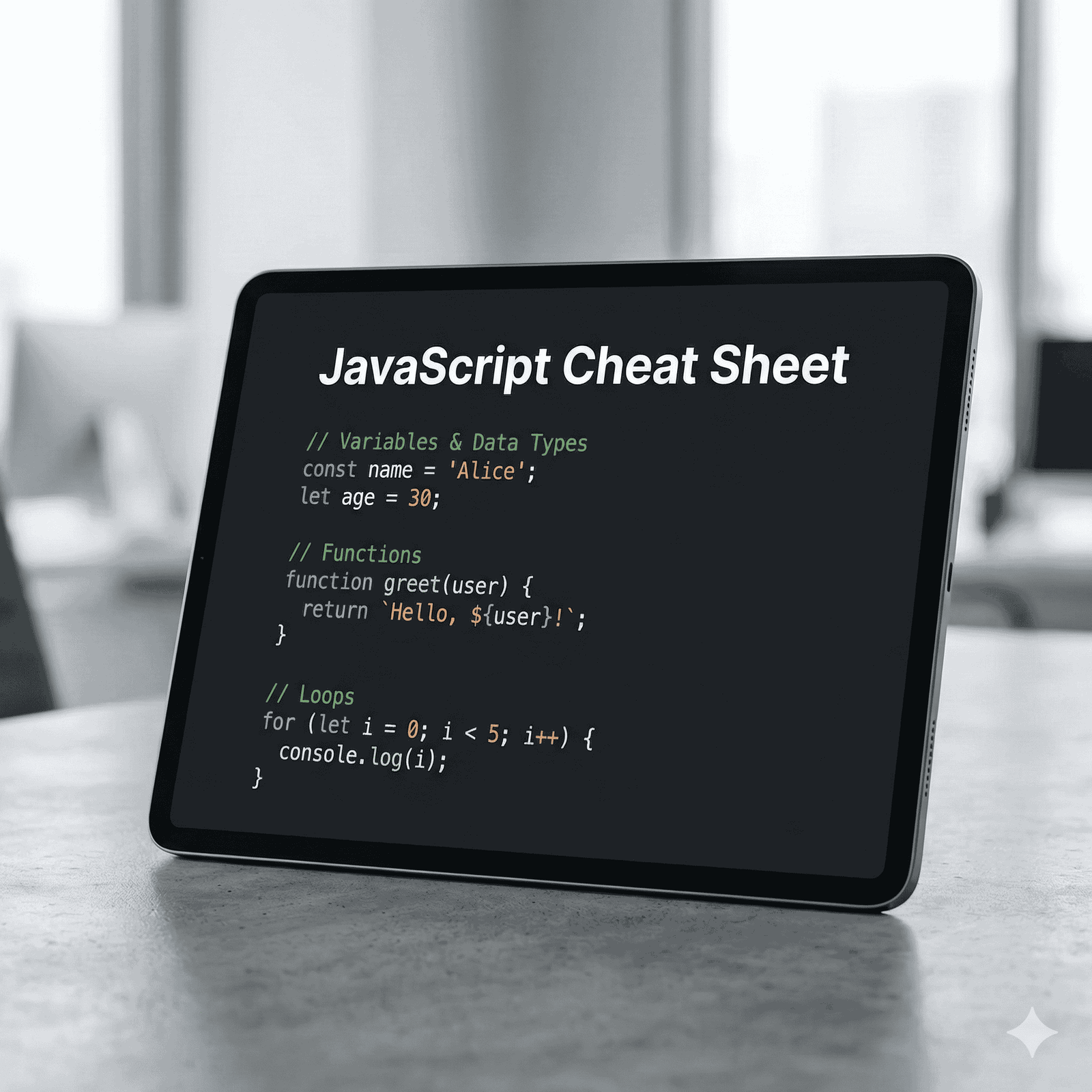
JavaScript ES6+ Features Cheat Sheet
Master modern web development instantly with our comprehensive JavaScript ES6 cheat sheet, ES6 features reference, modern JavaScript syntax guide, JS ES6+ quick ref, ECMAScript 6 cheat sheet! Stop searching through documentation and get immediate access to all the crucial features developers need today.
- Instantly reference all key ES6+ features, including Promises and Async/Await.
- Perfect for quick lookups on the Go-To Syntax for Modern JS.
- Boost your coding speed with concise, easy-to-read examples and definitions.
- Covers new additions beyond ES6, making it the most Up-to-Date Resource.
Download your essential JavaScript guide now and code smarter.
$10.99 Original price was: $10.99.$0.54Current price is: $0.54.
Payment Methods:
Description
Ditch the Documentation: Master Modern JavaScript Instantly with the Ultimate JavaScript ES6+ Features Cheat Sheet
Are you tired of constantly searching online documentation for arrow functions, Promises, or destructuring syntax? In today’s fast-paced development world, fluency in modern JavaScript is non-negotiable. That’s why every serious developer needs the ultimate JavaScript ES6 cheat sheet—a single source of truth that cuts through complexity and gets you coding faster. ECMAScript 2015 (ES6) marked a revolutionary turning point for the language, introducing dozens of features that enhance readability, efficiency, and performance. However, keeping all these new concepts straight—from template literals to class syntax—can be overwhelming. Our comprehensive guide eliminates that frustration, providing you with a concise ES6 features reference designed for instant recall. If you want to elevate your code quality and efficiency, mastering these updates is the only way forward. Stop wasting time deciphering old tutorials and start leveraging the power of a complete ECMAScript 6 cheat sheet designed for the developer who values speed and accuracy.
Why You Need This Modern JavaScript Syntax Guide Now
The transition from older versions of JavaScript to ES6+ (including ES7, ES8, ES9, and beyond) isn’t optional; it’s essential for working with modern frameworks like React, Angular, and Vue. Yet, many developers struggle to recall the exact syntax for less commonly used features, resulting in fragmented workflows and frustrating debugging sessions. Our resource acts as your personal high-speed reference, ensuring you spend less time searching and more time shipping code. Whether you are a student learning the ropes or a veteran pivoting to a new project, this modern JavaScript syntax guide is engineered to streamline your development process.
Key Features That Define the Modern JavaScript Experience
ES6 introduced core changes that fundamentally reshape how we write JavaScript. These additions are not just superficial; they address long-standing limitations of the language and make complex asynchronous operations manageable. Here is a brief look at some of the non-negotiable features covered instantly in our guide:
- Arrow Functions: A concise way to write functions, offering lexical
thisbinding that solves one of JavaScript’s most notorious quirks. Our cheat sheet provides clear syntax for implicit returns and single-parameter handling. - Promises & Async/Await: Revolutionizing asynchronous programming. Say goodbye to callback hell! Learn the correct structure for
.then(),.catch(), and the elegant simplicity ofasyncandawaitfor writing asynchronous code that looks synchronous. - Classes: While still syntactic sugar over JavaScript’s prototype-based inheritance, the
classkeyword allows developers coming from object-oriented languages to structure their code using familiar concepts of constructors, methods, and inheritance (viaextendsandsuper). - Destructuring Assignment: This powerful feature allows you to extract values from arrays or properties from objects into distinct variables quickly and easily. It’s perfect for accessing configuration objects or handling data returned from APIs.
- Spread and Rest Operators: The three dots (
...) are indispensable. The rest operator collects elements into an array, while the spread operator expands iterable elements (like arrays or strings) into individual elements.
Immediate Benefits of Using Our JS ES6+ Quick Ref
Time is money, especially in software development. Relying on slow searches and outdated resources means lost productivity and increased project timelines. Our solution offers tangible, immediate benefits that translate directly into better code and faster delivery:
1. Unmatched Speed: With a physical or digital copy of this JS ES6+ quick ref always at hand, you eliminate the cognitive load associated with recalling specific function signatures or new keyword usage. Need to write an immediately invoked arrow function? The syntax is right there, saving you 3-5 minutes of Googling.
2. Boosted Code Quality: Modern JavaScript features like modules (import/export) and let/const are crucial for writing maintainable, bug-free code. Our guide ensures you are always using best practices and the most efficient syntax available, reducing errors caused by variable scope issues (a notorious problem with old var declarations).
3. Enhanced Interview Performance: Technical interviews often focus heavily on your fluency in modern ES6+ features. Developers who can quickly demonstrate mastery of Promises, generators, or the Module system stand out. Using this resource as a study aid will solidify your knowledge and dramatically improve your confidence in technical screenings.
Deep Dive: Promises, Async/Await, and Asynchronous Mastery
One of the largest hurdles for JavaScript developers transitioning to modern development is asynchronous code. Before ES6, developers primarily relied on callbacks, which led to nested code structures that were hard to read and manage—the dreaded “callback hell.” ES6 tackled this directly with Promises, and later additions streamlined it further with async/await.
Promises are simply objects representing the eventual completion (or failure) of an asynchronous operation and its resulting value. They provide a standardized way to handle asynchronous flow. Our JavaScript ES6 cheat sheet breaks down the Promise API into easily digestible sections:
- Creating a new Promise (
new Promise((resolve, reject) => {...})) - Chaining operations (
.then()) - Error handling (
.catch()) - Combining multiple asynchronous tasks (
Promise.all()andPromise.race())
Building on Promises, async and await (introduced in ES8) make asynchronous code look and behave like synchronous code, greatly improving readability. The async keyword is used to declare an asynchronous function, and await can only be used inside such a function to pause execution until a Promise resolves. This simple addition has profoundly improved developer ergonomics. Our ES6 features reference includes numerous real-world examples demonstrating how to refactor old callback-style code into clean, modern async/await patterns.
Don’t let the sheer volume of updates intimidate you. With the right resource, mastering the nuances of modern JavaScript is faster and easier than ever before. This guide is your indispensable toolkit for writing cleaner, faster, and more robust code today. Download your copy and transform your JavaScript development workflow immediately.